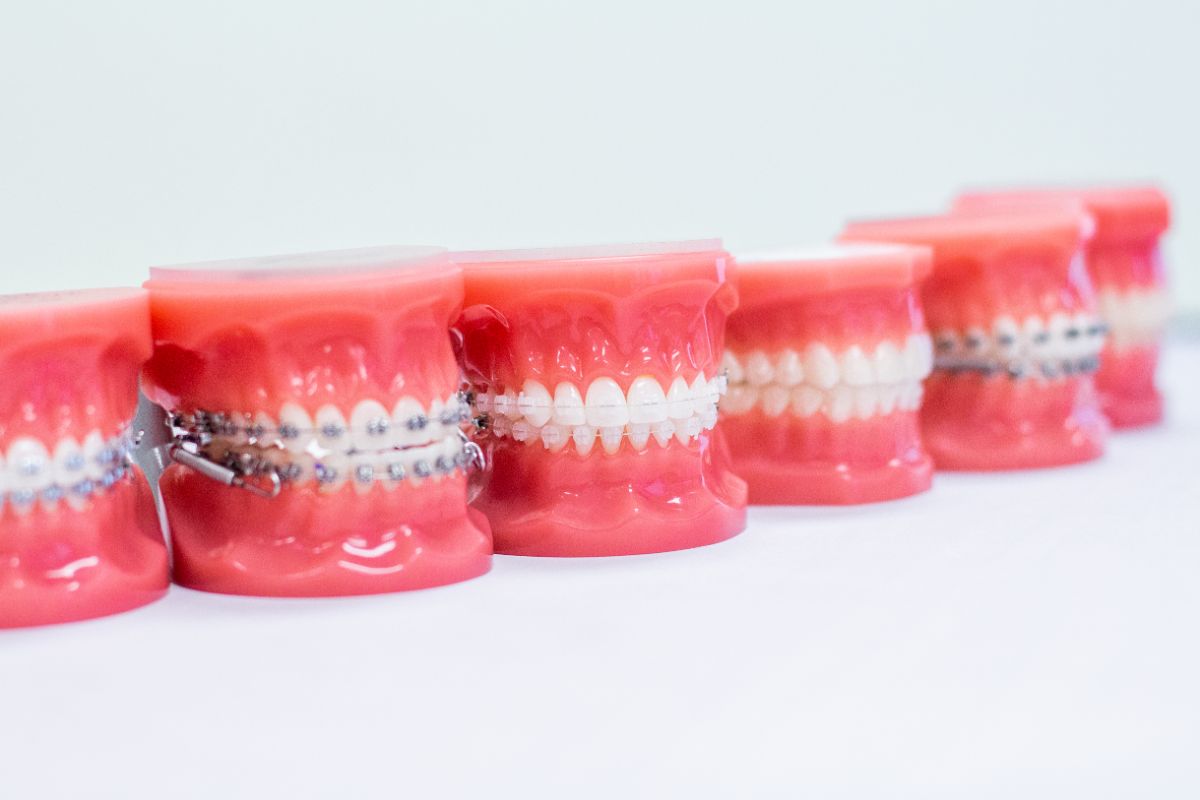
If you are weighing orthodontic treatment options for yourself or your family in Collierville, one of the first decisions you will face is whether to go with traditional braces or clear aligners. Both treatments can deliver beautiful, straight smiles. Neither is universally better than the other. The right choice depends on your case, your lifestyle, and your goals. This guide breaks down how each option works, what they cost, and which type of patient benefits most from each approach.
The Quick Comparison
| Factor | Traditional Braces | Clear Aligners (Invisalign) |
|---|---|---|
| Visibility | Visible, though ceramic options blend in | Nearly invisible |
| Removable | No, fixed to the teeth | Yes, removed for eating and cleaning |
| Compliance required | Low (works automatically) | High (must be worn 20 to 22 hours a day) |
| Complex cases | Excellent | Good for mild to moderate cases |
| Food restrictions | Some (hard, sticky foods) | None |
| Oral hygiene | More challenging | Easier |
| Office visits | Every 6 to 8 weeks | Every 8 to 12 weeks |
| Typical cost in Collierville | $3,000 to $7,000 | $4,000 to $7,500 |
How Traditional Braces Work
Traditional braces use metal or ceramic brackets bonded to each tooth, connected by a thin archwire. Small elastic bands or built-in clips hold the wire in place. The wire applies consistent, gentle pressure on the teeth, and your orthodontist adjusts it at regular appointments to guide each tooth into its final position.
Braces are fixed, which means they work 24 hours a day, seven days a week. You cannot take them off, lose them, or forget to wear them. That continuous pressure is part of why braces are so predictable and effective, especially for complex cases.
The main downsides: braces are visible, they come with some food restrictions, and oral hygiene takes more effort. Modern brackets are much smaller and smoother than older versions, and ceramic braces provide a less obvious alternative for patients who want a more discreet option.
How Clear Aligners Work
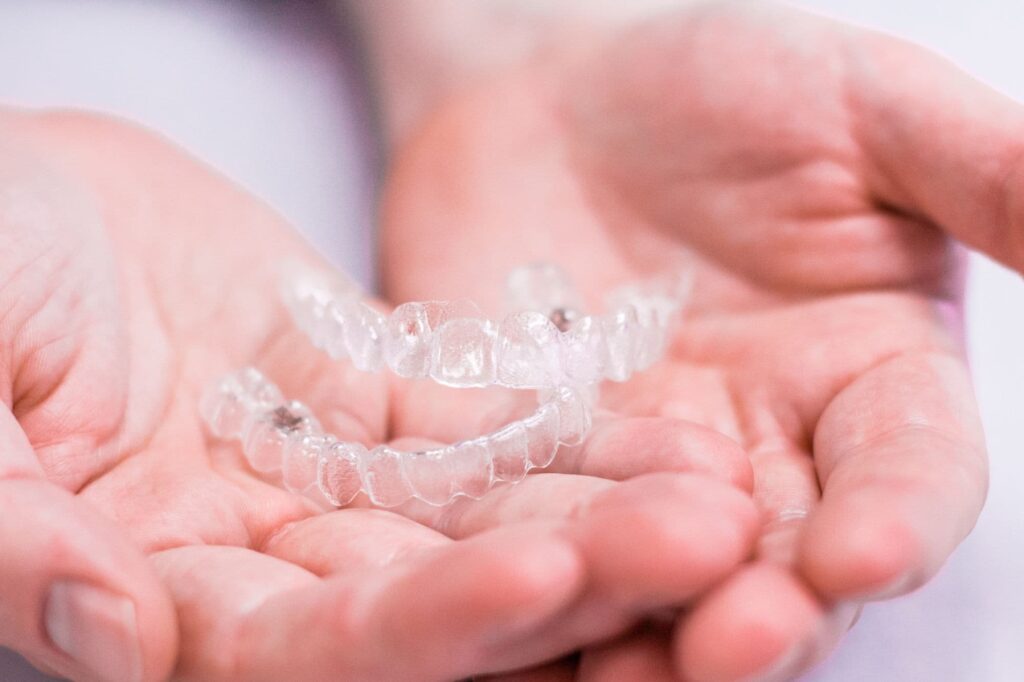
Clear aligners are a series of custom-made plastic trays that fit over the teeth. Each tray is designed to shift specific teeth by a small amount. Patients wear each tray for one to two weeks, then switch to the next one in the series. Over the course of treatment, typically 12 to 18 months for most adults, the trays gradually move the teeth into their final positions.
Invisalign is the most widely used and clinically supported clear aligner system. When patients or orthodontists refer to “clear aligners,” they are usually referring to Invisalign specifically.
Aligners are removable, which is both their biggest advantage and their biggest limitation. You take them out to eat, drink anything other than water, brush, and floss. That removability eliminates food restrictions and makes oral hygiene much easier. It also means treatment only works if the patient is disciplined enough to wear the aligners for 20 to 22 hours a day, every day.
Which Treatment Is Better for Complex Cases?
Traditional braces. This is one of the clearest distinctions between the two options. Braces give orthodontists more precise control over individual tooth movement, which matters when the case involves:
- Significant bite correction (overbite, underbite, crossbite)
- Severe crowding or spacing
- Rotations that require extensive movement
- Teeth that need to move vertically (up or down) in the mouth
- Growth modification in kids and teens
Modern Invisalign can handle many more cases than it could a decade ago, including some moderately complex ones. But for patients with significant issues, braces remain the more reliable, predictable option.
Which Treatment Is Better for Aesthetics?
Clear aligners. This is where Invisalign has the clearest advantage. Most people will not notice you are wearing them, which makes a real difference for adults who spend time in front of clients, cameras, or colleagues. Professional appearances, weddings, and other major life events are far less stressful when your treatment is invisible.
Ceramic braces offer a middle ground. The tooth-colored brackets blend in more naturally than metal, though they are still visible up close. For patients who prefer the effectiveness of fixed braces but want a less obvious look, ceramic braces are a solid compromise.
Which Treatment Fits Better With Daily Life?
This depends heavily on the patient. Here is a realistic breakdown:
Braces fit better when:
- The patient is a younger child or early teen still building habits
- Consistent compliance with a removable appliance would be a challenge
- The patient does not want to think about orthodontics between appointments
- Cost is a meaningful factor
Clear aligners fit better when:
- The patient is an adult with a professional job
- Aesthetics during treatment are important
- The patient travels frequently or has an irregular schedule
- The patient prefers fewer in-office visits
- Oral hygiene is a priority (braces require more effort to clean around)
At Saddle Creek Orthodontics, we see many Collierville families where different members choose different treatments. A teen might get traditional braces while a parent gets Invisalign. Both work well for the right case.

How Long Does Each Treatment Take?
Treatment length depends on the complexity of the case, not the treatment option. A simple case of mild crowding can finish in 12 months with either treatment. A comprehensive case involving bite correction can take 24 months or more with either option.
That said, there are some general patterns:
- Braces: Average treatment time of 18 to 24 months for comprehensive cases.
- Invisalign: Average treatment time of 12 to 18 months for most adult cases. Simple cases can finish in 6 to 9 months.
Your orthodontist will give you a specific timeline based on your case at the consultation.
How Much Does Each Treatment Cost in Collierville?
Cost varies by case, but here are typical ranges for Collierville patients:
- Traditional metal braces: $3,000 to $6,500
- Ceramic (clear) braces: $3,500 to $7,000
- Invisalign: $4,000 to $7,500
Most insurance plans cover both treatments at the same rate. Payment plans, HSA and FSA funds, and family discounts typically apply to both. The cost difference between braces and Invisalign is often smaller than patients expect.
What About Self-Ligating Braces or Lingual Braces?
A couple of specialty options worth mentioning:
Self-ligating braces work like traditional braces but use a small built-in clip instead of elastic bands to hold the wire. They can reduce friction and sometimes require fewer adjustments, though the difference in total treatment time is usually modest.
Lingual braces are placed on the back of the teeth instead of the front, making them completely invisible from the outside. They are effective but more expensive, harder to clean, and not every orthodontist offers them.
For most Collierville patients, the choice comes down to traditional braces (metal or ceramic) versus Invisalign.
The Honest Recommendation
For most patients, the deciding factor is not the treatment itself. It is the patient. The best orthodontic outcome is the one where the patient actually follows through with the plan. A disciplined adult will do beautifully with Invisalign. An active young teen will often do better with braces they cannot forget to wear.
At your consultation, Dr. Kyle Fagala or Dr. John Boling will honestly tell you which option will produce the best result for your specific case. Sometimes that recommendation surprises patients who came in expecting to hear one answer and got another. But a good orthodontist prioritizes the outcome, not the sale.
Common Questions Collierville Patients Ask
Can I switch from braces to Invisalign (or vice versa) once I start? In most cases, yes, though it may involve some added cost and time. We try to identify the right option from the start so this is rarely needed.
How do I know if I have the discipline for Invisalign? Honest self-reflection helps. If you already have strong daily routines (consistent brushing, regular meals at set times, general reliability), you will likely do well. If you are prone to misplacing things or skipping routines, braces may be easier.
Is treatment painful? Neither option is significantly painful. Both involve some soreness in the first few days and after adjustments or tray changes. Over-the-counter pain relievers are usually sufficient.
What about treatments like SureSmile or other aligner brands? Several clear aligner systems exist beyond Invisalign. Invisalign has the longest track record and most clinical research, which is why most experienced orthodontists default to it. At Saddle Creek, we evaluate each case and recommend the system that will deliver the best outcome.
Will I need a retainer after treatment regardless of which option I choose? Yes. Retainers are lifelong for both treatments. Teeth naturally try to drift back over time, so retainer wear is the final piece of any successful orthodontic treatment.
Next Step: A Free Consultation in Collierville
The only way to know which treatment is right for you is a full evaluation with an experienced orthodontist. At our Collierville office, every new patient consultation includes a clinical exam with a board certified orthodontist, 3D digital imaging, a specific treatment recommendation, and a transparent cost breakdown.
You leave knowing exactly what you are working with and what your best path forward looks like. No pressure, no obligation, no pushy sales tactics.
Schedule your free consultation with Saddle Creek Orthodontics today.